



Strategic Outcomes: A Guide to Securing Public and Grant Funding for Professional Growth
In the current fiscal landscape, securing education grant funding has become a top priority for leaders in education, government, and the non-profit sector has shifted. Whether you are navigating school district budgets or state agency grants, the criteria for funding should prioritize three things: measurable impact, long-term sustainability, and operational efficiency.
Securing funding for a platform like TORSH Talent isn’t about chasing the latest trend—it’s about demonstrating how technology serves as a bridge between high-level goals and day-to-day results.
1. Identifying Education Grant Funding Buckets
To unlock sustainable funding, it is essential to align your request with the specific performance goals of the grantor. Here is where we see the most success:
- Linguistic Resource Management (Title III): As the workforce and student populations become more linguistically diverse, grantors are looking for ways to optimize these “language assets.” With TORSH’s new Bilingual Learner support features, organizations can apply for funds aimed at National Professional Development (NPD) and English Language Acquisition, focusing on clear communication and instructional precision.
- Implementation Science & Research Fidelity (IDEA): For projects bridging the gap between research and practice, funds like IDEA (Part B & C) are ideal. These grants prioritize tools that can prove an intervention is being delivered as designed.
- Regional Accessibility & Infrastructure: Many state and federal grants are currently focused on “Closing the Distance Gap.” By using a remote coaching platform, you can argue for funds that support Rural and Under-resourced Communities by removing the need for costly travel.
2. Partner Spotlight: Data-Backed Excellence with KU Juniper Gardens
A successful grant application is built on evidence. We see this in the work of the University of Kansas Juniper Gardens Children’s Project.
Their programs—such as FITBI (Family-Implemented Treatment for Behavioral Inflexibility) and CW-FIT (Class-Wide Function-related Intervention Teams)—utilize TORSH as a System of Record. By using time-stamped video feedback, they achieve:
- Verification of Treatment Integrity: Providing the “proof of performance” that federal reviewers demand to ensure interventions are being delivered as intended.
- Continuous Support Loops: Moving away from the “one-and-done” workshop model to a sustainable, iterative cycle of improvement.
- Operational Scale: Allowing a small team of experts to support a vast network of families and educators effectively, regardless of their physical location.
3. Strategy: Maximizing Multilingual Professionalism
In 2026, the ability to support a multilingual workforce is a competitive advantage. Rather than framing this through a social lens, frame it as Strategic Human Capital Development.
With the launch of our Bilingual Learner support, TORSH allows organizations to:
- Enhance Retention: Support educators and staff in their primary language to increase job satisfaction and professional efficacy.
- Standardize Quality: Ensure that high-quality, nuanced feedback is not “lost in translation” across different language groups.
- Meet Specialized Grant Criteria: Align with federal and state grants that specifically fund the training and certification of bilingual and dual-language professionals.
4. Writing a Winning “Technical” Proposal
When you describe TORSH in a grant application, focus on the Technical Infrastructure. Avoid emotive language and focus on the mechanics of professional growth.
The “ROI” Hook: > “By utilizing an asynchronous feedback loop, this project ensures that professional growth is continuous, documented, and measurable. This creates a permanent Digital Library of Practice that remains a high-value asset to the organization long after the initial grant period ends.”
Free Resource: The 2026 Professional Growth Grant Toolkit
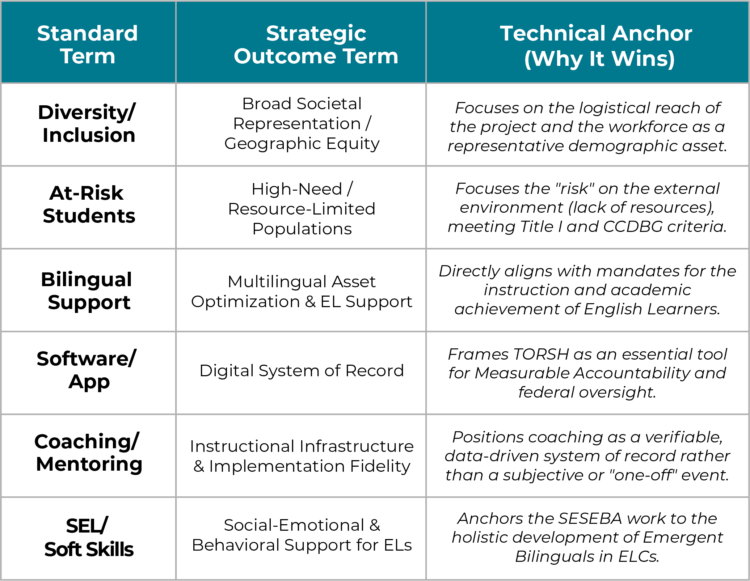
To help you navigate these conversations, we’ve put together a one-page “Strategic Language Matrix” that replaces vague buzzwords with the high-impact, technical terms grantors are looking for today.
Toolkit Preview: The 2026 Strategic Language Matrix
Appendix—2026 Funding Opportunities to Watch
For organizations looking to secure funding for TORSH Talent this year, we recommend monitoring these high-priority federal and state programs. Each aligns with the “Outcome-Based” and “Fidelity” metrics built into the TORSH platform.
Title III, Part A (English Language Acquisition):
Focus: Improving instruction for English Learners (ELs) and immigrant students.
The TORSH Angle: Use these funds to implement Bilingual Learner support, ensuring that coaches and EL educators can communicate with technical and cultural precision.
National Professional Development (NPD) Grants:
Focus: Professional development for educators working with Emergent Bilinguals.
The TORSH Angle: TORSH serves as the essential infrastructure for the “asynchronous mentorship” required to scale these programs across high-need districts.
IDEA Part B & C (Special Education & Early Intervention):
Focus: Ensuring Intervention Fidelity for children with disabilities.
The TORSH Angle: Ideal for projects modeled after the KU Juniper Gardens approach, utilizing video for the verification of treatment integrity.
CCDBG (Child Care and Development Block Grant):
Focus: Increasing the quality of child care services.
The TORSH Angle: Perfect for state-level Quality Rating and Improvement Systems (QRIS) and supporting Early Learning Centers (ELCs) through remote observation.