



What Teacher Prep Programs Should Look for in a Coaching Platform for Clinical Supervision

Clinical experience is where teacher candidates learn the most, and where programs have the least visibility. Candidates are spread across dozens of schools and centers. University supervisors can only be in so many classrooms in a week. Mentor teachers are giving feedback too, but it doesn’t always line up with what faculty are teaching. And at the end of the term, programs still need clear evidence of how each candidate grew.
A lot of programs are still holding this together with observation forms, email threads and shared drives. It works, until it doesn’t. Here’s what to look for in a coaching platform that can actually support clinical supervision, and the questions worth asking before you choose one.
Why Clinical Supervision Gets Harder to Scale
Most teacher prep programs run into the same few problems:
- Placements are spread out: Supervisors spend real time driving between sites, which cuts into time for observing and giving feedback.
- Feedback isn’t consistent: Supervisors, mentor teachers and faculty may use different language, or different versions of the same rubric.
- Candidates get feedback too late: By the time they hear back on a lesson, they’ve already taught several more.
- Evidence is scattered: Observations, reflections and evaluations live in different places, which makes portfolios and accreditation reporting a scramble.
What Strong Clinical Supervision Needs
Good clinical supervision isn’t one observation and a score. It’s an ongoing cycle where candidates practice, reflect and get feedback tied to clear goals. That usually includes:
- Observation of real teaching: In person when it’s possible, and through video when it’s not.
- Feedback tied to specific moments: Comments on what actually happened in a lesson, not general notes after the fact.
- Self-reflection: Candidates review their own teaching before or alongside supervisor feedback.
- Shared rubrics and goals: Everyone working with a candidate uses the same language for what good practice looks like.
- A record of growth over time: Something that shows progress across the whole placement, not just a single snapshot.
Features to Evaluate (and Questions to Ask)
Video Observation With Time-Stamped Feedback
Candidates should be able to record a lesson and share it, and supervisors should be able to leave comments tied to exact moments.
Ask: Can candidates record and upload easily from a phone? Can supervisors and mentor teachers both leave feedback on the same video?
Your Rubrics, Not Someone Else’s
Your program already has the competencies and observation tools it uses. The platform should support those instead of replacing them.
Ask: Can we build our own rubrics and observation forms? Can different programs or courses use different ones?
Self-Reflection and Peer Review
Candidates learn a lot from watching their own teaching, and from seeing how classmates handle similar moments.
Ask: Can candidates complete self-assessments on their own videos? Can we set up peer review within a cohort?
Goal Setting Across the Placement
Feedback works best when it connects to a few clear goals that carry from one observation to the next.
Ask: Can supervisors and candidates set goals together and track progress against them?
Portfolios and Program-Level Data
Programs need two views: each candidate’s growth, and patterns across the whole program.
Ask: Can candidate work be organized into portfolios? Can we pull program-level reports for accreditation and program review?
Access for Everyone Involved
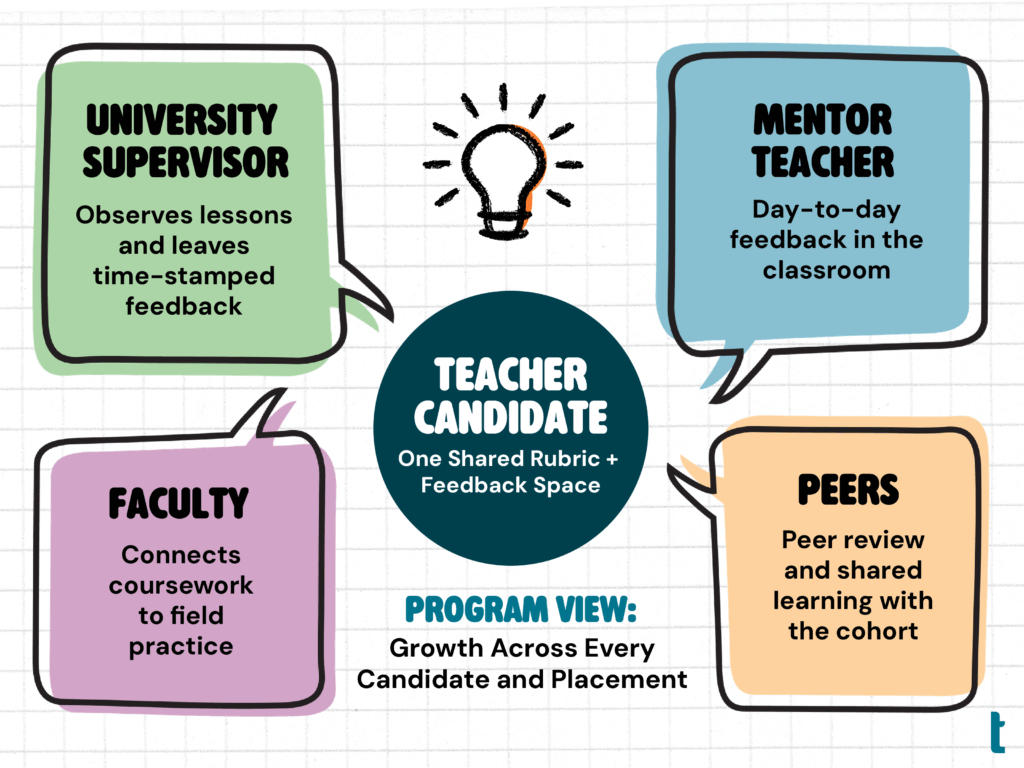
Clinical supervision includes faculty, supervisors, mentor teachers and candidates, often across different organizations.
Ask: Can we give the right people the right access, without everyone seeing everything?

For EI and ECSE Programs: Bringing the DEC Recommended Practices Into Coursework
Programs preparing early interventionists and early childhood special educators have an extra layer: candidates need to know the DEC Recommended Practices and be able to put them into practice in the field.
That’s where DEC Certify comes in. Built through TORSH’s partnership with the Division for Early Childhood (DEC), DEC Certify brings DEC’s Recommended Practices into ready-to-use online courses, starting with Teaming & Collaboration. Each course is aligned to the EI/ECSE Standards, using DEC’s crosswalk with the Recommended Practices, and students can take the courses as part of their program. DEC Certify is launching in early 2027. Get early access →

Where TORSH Fits
TORSH is the infrastructure that makes professional growth stick, including for the educators who haven’t started their careers yet. For teacher prep programs, TORSH Talent connects coursework to field experience with video observation, time-stamped feedback, self-reflection, shared rubrics and goal tracking, all in one place and accessible from any device.
TORSH is framework-flexible, so programs bring their own rubrics and competencies. TORSH helps faculty, supervisors and mentor teachers give candidates consistent feedback across every placement, and gives programs the data to show how candidates grow.
Want to see how it works for your program? Request a demo →
Frequently Asked Questions
What is clinical supervision in teacher preparation?
Clinical supervision is the support teacher candidates get during field placements and student teaching. Supervisors and mentor teachers observe candidates teaching, give feedback, and help them set and work toward goals for their practice.
How can programs supervise teacher candidates across many placements?
Video observation lets candidates record lessons and share them with supervisors, who can give time-stamped feedback without traveling to every site. That leaves more time for feedback and less for driving.
What should a coaching platform for teacher prep include?
Look for video observation with time-stamped feedback, support for your own rubrics, self-reflection and peer review, goal tracking, portfolios and program-level reporting.
How do teacher prep programs keep feedback consistent across supervisors and mentor teachers?
By using shared rubrics and a single place for feedback. When everyone working with a candidate uses the same language and can see the same history, feedback lines up.
What is DEC Certify?
DEC Certify brings the Division for Early Childhood’s Recommended Practices into ready-to-use online courses, built through TORSH’s partnership with DEC. The courses are aligned to the EI/ECSE Standards, and students can take them as part of their program.