


Supporting Early Intervention Providers Between Trainings: How to Make Coaching Stick
Most early intervention providers know the pattern. There’s a training, everyone leaves with good ideas, and then the work picks back up: a full caseload, sessions in different settings, travel in between and documentation at the end of the day. A few weeks later, most of what was covered in that training hasn’t fully made it into day-to-day practice.
That isn’t a motivation problem – it’s a support problem. EI providers often work on their own, spread out across settings, with limited time for a coach or supervisor to see their practice and give feedback. So the question for program leaders isn’t whether to train. It’s how to keep supporting providers after the training ends.
Why One-Time Training Doesn’t Stick In Early Intervention
Early intervention has a few things working against follow-through:
- Providers work independently. Sessions happen across different settings and schedules, often far from a supervisor.
- Coaches can’t be everywhere. Travel time eats into the hours a coach has to actually observe and give feedback.
- Feedback comes late, or not at all. By the time a provider hears back, the moment has passed.
- Programs can’t see what’s working. Without a way to track practice over time, it’s hard to know if a new approach is being used, or where a team needs more help.
None of this means training is wasted. It means training is the starting point, not the finish line.
What Ongoing Coaching and Support Looks Like for EI Teams
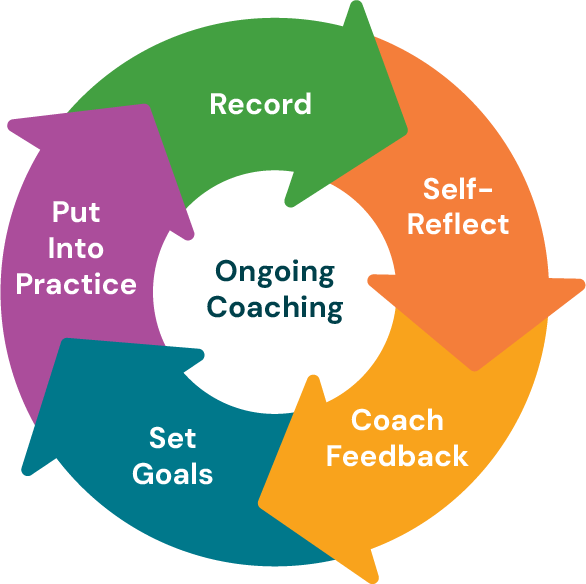
Ongoing coaching in early intervention means providers get regular, practice-based feedback between formal trainings and tied to the practices they’re learning with the goals they’ve set with a coach.
In practice, that usually includes:
- A clear focus: One or two practices to work on at a time, not everything at once.
- Regular check-ins: Short, consistent touchpoints instead of one big review a year.
- Feedback tied to real moments: Comments on what actually happened in a session, not general advice.
- Goal setting and reflection: Providers and coaches agree on what growth looks like and revisit it.
- Shared tools across the team: Everyone uses the same rubrics and language, so feedback is consistent from coach to coach.
This kind of support works best when it fits into the work providers are already doing, rather than adding another thing to their week.
Making It Practical: Video, Feedback and Documentation
For teams spread across different settings, video is one of the simplest ways to close the distance. A provider can record a moment from their work (with the right consent and privacy steps in place) and share it with a coach. The coach watches when they have time and leaves feedback tied to specific moments in the video – no drive across the county required.
A few things matter when choosing how to do this:
- Security: EI work involves sensitive information, so video and notes need to be stored securely.
- Time-stamped feedback: Comments linked to exact moments are easier to act on than a general summary.
- One place for documentation: Notes, goals and feedback live together, so nothing gets lost between sessions.
- Any device, any time: Providers and coaches can participate from a phone, tablet or laptop, which matters when schedules don’t line up.
What Program Leaders Can Track
Ongoing coaching also gives program leaders something they rarely have: visibility. Instead of relying on a single annual review, leaders can see how support is actually going across the team. That can include:
- How often providers are getting coaching and feedback
- Progress on individual and team goals over time
- Rubric data that shows how practice is shifting
- Where a team or individual might need more support
That data helps with more than internal planning. It gives leaders a clearer story to share with funders, state partners and their own teams about what their professional development is actually doing.
Where TORSH Fits
TORSH is the infrastructure that makes professional growth stick. For early intervention programs, that means supporting providers, coaches and program leaders with secure video, time-stamped feedback, goal setting and reporting, all in one place and accessible from any device.
TORSH is framework-flexible, so programs can bring the practices and rubrics they already use. TORSH helps put them into day-to-day practice, consistently, across the whole team.
At Florida State University’s Communication and Early Childhood Research and Practice Center, TORSH Talent supports a peer coaching model that trains experienced early intervention providers to coach others within their own agencies.
The data shows that the peer coaching works. The providers are more confident in their coaching, their implementation of the key indicators improves, and they increase their skills supporting the caregivers.
– Katrina Cripe, Florida State University
For programs grounded in DEC’s Recommended Practices, there’s more on the way. Through TORSH’s partnership with the Division for Early Childhood (DEC), DEC Certify will bring the Recommended Practices into ready-to-use online courses, starting with Teaming & Collaboration. Reserve early access →

Frequently Asked Questions (FAQs)
What is coaching in early intervention?
Coaching in early intervention is ongoing, practice-based support for providers. A coach helps a provider focus on specific practices, gives feedback on real moments from their work and tracks progress on shared goals over time.
How can EI programs support providers who work in different settings?
Video-based coaching lets providers share moments from their work with a coach without either of them traveling. Coaches can give time-stamped feedback on their own schedule, so support doesn’t depend on being in the same place at the same time.
Is video coaching secure enough for early intervention?
It can be, as long as the platform stores video and notes securely and programs follow their own consent and privacy procedures.
How do program leaders know if coaching is working?
By tracking things like coaching frequency, goal progress and rubric data over time. That shows whether practice is actually changing and where more support is needed.
What is DEC Certify?
DEC Certify is an upcoming offering from TORSH and the Division for Early Childhood (DEC) that brings DEC’s Recommended Practices into ready-to-use online courses.
Want to see how EI programs use TORSH to support providers between trainings? Request a demo →