



The Best Professional Learning & Coaching Platforms for Early Intervention Teams

Early Intervention (EI) teams don’t fit neatly into the tools built for traditional education. Providers aren’t in classrooms — they’re in homes, daycare centers, and community settings, working one-on-one with infants, toddlers, and families in the most personal environments imaginable. The coaching and professional learning infrastructure that works for a K-12 district doesn’t translate here.
And yet, many EI programs are still trying to make it work with tools that were never designed for them — generic LMS platforms built for compliance tracking, or video conferencing tools repurposed for something they weren’t built to do. The result is coaching that’s inconsistent, documentation that’s scattered, and professional growth that stalls out because the system isn’t designed for how EI providers actually work.
This guide compares the platforms EI teams are most commonly evaluating and makes the case for what actually fits.
What Makes Early Intervention Professional Learning Different
Before comparing platforms, it’s worth naming what makes EI unique — because the requirements are meaningfully different from general K-12 professional development.
Privacy compliance is non-negotiable.
Home-visit recordings capture infants, toddlers, and families in private settings. Any platform handling this footage must be formally HIPAA and FERPA compliant — not just secure, but compliant — with access controls that protect families and meet federal standards. This alone eliminates most generic tools from consideration.
Coaching has to happen without travel.
EI providers are distributed across wide geographic areas. Supervisors who need to observe and coach dozens of providers can’t be physically present for every home visit. Asynchronous video coaching — where providers record sessions, upload them securely, and receive structured feedback from coaches — is the only model that scales in this environment.
Frameworks need to be family-centered.
EI coaching isn’t about classroom instruction. It’s about building provider capacity to support family routines and natural environments. Platforms need to support frameworks like the Rush & Shelden coaching model and other family-centered approaches — not retrofit K-12 observation rubrics onto a fundamentally different context.
Accountability data has to connect to funder requirements.
Part C accountability standards require EI programs to demonstrate coaching fidelity, provider growth, and family engagement outcomes. A platform that can’t generate that data isn’t just inconvenient — it’s a liability at reporting time.
The Top Professional Learning Platforms for Early Intervention Teams
1. TORSH Talent — Best Overall for Early Intervention
TORSH Talent is a purpose-built professional learning, observation, and video coaching platform with deep experience serving early childhood, early intervention, and home-visiting teams. It is the only platform in this comparison purpose-built for the specific privacy, coaching, and accountability requirements of EI work.
HIPAA & FERPA Compliance
TORSH operates a dedicated, separately credentialed platform environment for HIPAA and FERPA compliance — not just a policy, but infrastructure. Home-visit recordings are stored and shared within a compliant system that meets federal standards for handling footage of infants, toddlers, and families in private settings. Teams working in EI can use TORSH with confidence that privacy requirements are fully covered.
Asynchronous Educator Observation & Video Coaching
Providers record home-visit sessions and upload them directly to TORSH from any device — phone, tablet, or laptop. Supervisors review footage on their own schedule, leave timestamped feedback tied to specific moments in the recording, and respond to providers without coordinating a live meeting or driving across a service area. Coaching happens consistently, regardless of geography.
Family-Centered Framework Support
TORSH supports customizable coaching rubrics built around the frameworks EI teams actually use — including the Rush & Shelden coaching model and other family-centered approaches focused on natural-environment routines and caregiver capacity building. Teams bring their own frameworks into the platform; TORSH provides the infrastructure to make them consistent and scalable across every provider and site.
Decentralized Team Dashboards
Program directors and state agency leads can see coaching activity across their entire distributed team from a single dashboard — frequency, feedback patterns, provider engagement, and progress toward goals. When it’s time to report to funders or state agencies, the data is already there.
Best For: State EI programs, school districts, and community organizations needing structured, scalable, privacy-compliant coaching for home visitors, service coordinators, and early childhood specialists.
2. Standard K-12 Professional Learning Tools (e.g., Vector Solutions, Frontline)
These platforms were designed for district-wide compliance tracking and general teacher professional development. They do that job reasonably well for K-12 contexts — course completion tracking, credential management, broad-based PD delivery.
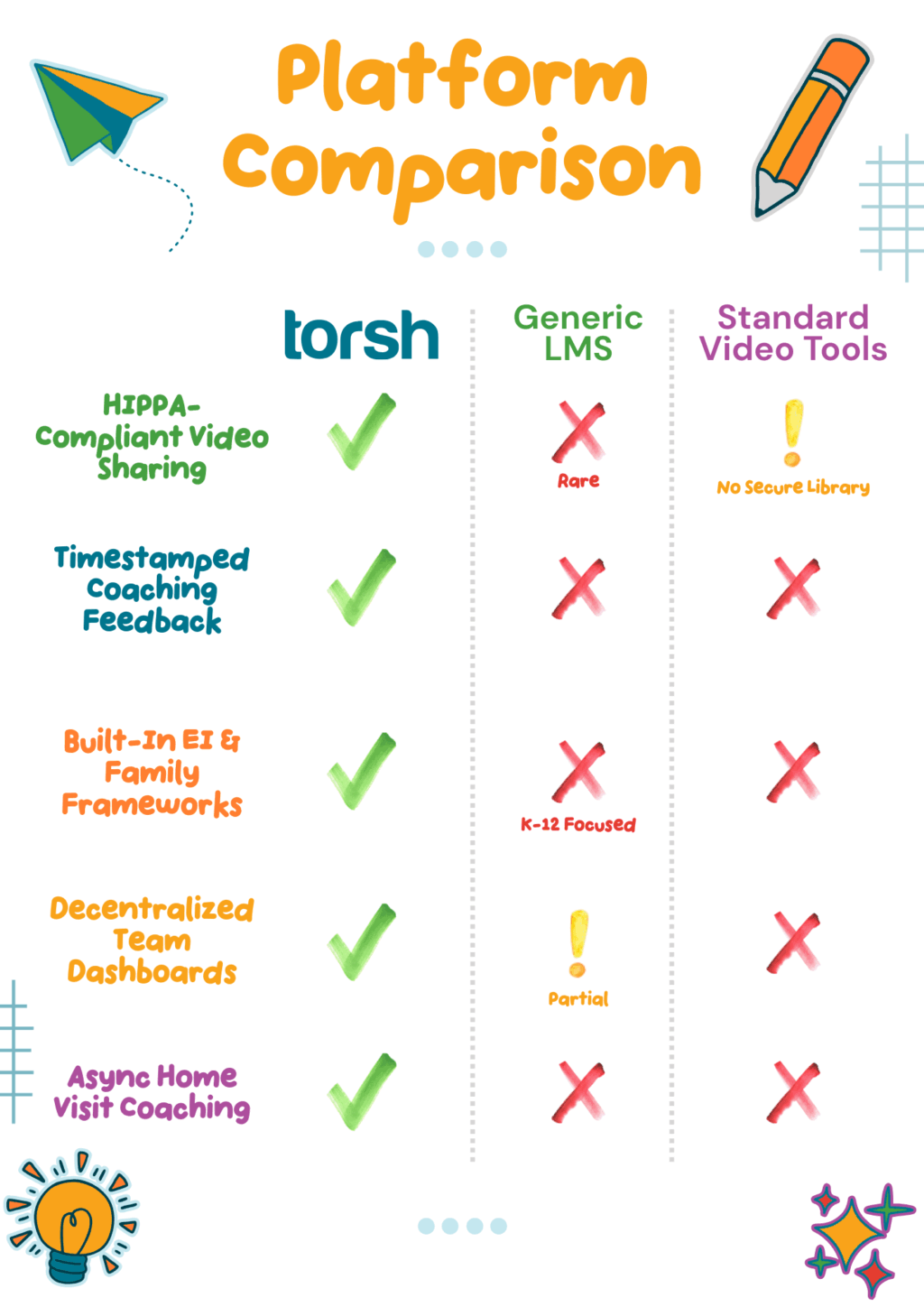
For EI teams, however, they fall short in the ways that matter most. They lack dedicated tools for home-visit video coaching, don’t offer HIPAA-level privacy controls for footage featuring families in private settings, and aren’t built around family-centered coaching frameworks. Observation and feedback tools, when they exist, are designed for classroom environments — not natural-environment, routine-based EI work.
Best For: General K-12 PD compliance and credential tracking.
Limitations for EI: Not built for home-visit video, family privacy compliance, or EI-specific coaching frameworks.
3. Generic Video Collaboration Tools (e.g., Zoom, Microsoft Teams)
Many EI programs have tried to adapt Zoom or Teams for coaching — and the appeal makes sense. These tools are familiar, accessible, and widely used. But they’re built for live, real-time meetings, not structured coaching cycles.
There is no timestamped feedback. No rubric alignment. No portfolio tracking over time. No centralized data on provider growth or coaching fidelity. Recordings exist, but they sit in a folder, disconnected from any coaching workflow or accountability system. And neither platform offers the HIPAA-compliant video storage environment that EI home-visit footage requires.
Using Zoom or Teams for EI coaching is the equivalent of using email for case management — technically possible, practically unsustainable.
Best For: Live meetings and real-time collaboration.
Limitations for EI: No structured coaching infrastructure, no HIPAA-compliant video library, no data tracking tied to provider growth or funder accountability.
Educator Coaching Platform Comparison
Why EI Teams Choose TORSH Talent
The tools EI programs are currently using were built for different problems. A K-12 compliance platform doesn’t know what a natural-environment coaching session looks like. A video conferencing tool doesn’t know what a coaching cycle is. Neither was built to handle the privacy requirements of footage featuring families in their homes.
TORSH Talent was. It bridges the gap between field-based practice and professional growth — giving providers a structured, private space to reflect on their work, giving supervisors the tools to coach without traveling to every session, and giving program leaders the data they need to demonstrate impact to the funders and state agencies who require it.
For EI teams that have been making do with tools that weren’t built for them, TORSH Talent is what purpose-built looks like.