


How to Choose an Educator Coaching Platform in 2026 | TORSH


If you’ve been tasked with finding an educator coaching platform, you already know the feeling: too many options, too many demos, and not enough time to sort out what actually matters. Meanwhile, the professional development budget is committed, the coaching calendar is set, and the pressure is on.
Choosing the wrong platform doesn’t just waste money. It wastes something harder to recover — educator trust. When a tool doesn’t work the way coaches actually work, people stop using it. And when people stop using it, the coaching culture you’ve been building quietly stalls.
This guide cuts through the noise. Whether you’re supporting early childhood educators across dozens of sites, building a coaching infrastructure for a K-12 district, or managing professional learning for a higher education or childcare organization, these are the criteria that actually matter — and the questions you should be asking before you sign anything.
What Separates Great Professional Learning Platforms from the Rest
The era of “buy it and figure it out” is over. Education leaders in 2026 are accountable for demonstrable outcomes — retention rates, instructional improvement data, coaching frequency — and their tools need to produce evidence, not just activity.
At the same time, educator time is finite and fiercely protected. A platform that creates more work than it removes will be abandoned, no matter how many features it has.
The right educator coaching platform doesn’t just store videos or track observations. It becomes the infrastructure your coaching program runs on — accessible, sustainable, and built around how educators actually work.

The 10 Criteria That Should Drive Your Decision
1. Does It Support Full Coaching Cycles — Not Just Video Recording?
Video capture is a feature. Coaching is a workflow.
The best platforms support the complete cycle: goal-setting, observation, structured feedback, reflection, and progress tracking over time. If a platform leads with “record a lesson,” ask what happens after the recording. Can coaches leave timestamped feedback? Can educators respond and reflect? Is there a trail of growth that administrators can actually see?
What to ask: Can I see what a complete coaching cycle looks like from start to finish inside the platform?
2. Can It Handle Educator Observations Across Multiple Sites?
For multi-site organizations — districts, early childhood networks, childcare management groups — the logistics of in-person observation are often the single biggest barrier to consistent coaching. Coaches burn hours in transit. Leaders can only be in one room at a time. Feedback is delayed, episodic, or simply doesn’t happen.
Asynchronous video observation changes the math entirely. Coaches can review a classroom in the time it would have taken to drive there. Leaders can monitor what’s actually happening across sites without leaving the building.
What to ask: Can coaches give feedback on recorded lessons without being physically present? Can I oversee activity across multiple sites from one dashboard?
3. Is It Truly Accessible — Any Device, Any Time?
“Accessible” is one of the most overused words in edtech. Press on it.
For early intervention coaches working in homes, childcare coaches without reliable desktops, or educators grabbing five minutes during a planning period — accessibility means the platform works on a phone. It means it doesn’t require a perfect Wi-Fi connection. It means recording, reviewing, and responding can happen at 7am or 7pm, not just during school hours.
What to ask: Can educators participate fully from a mobile device? Are there any features that require desktop access?
4. Does It Work Across Roles, Not Just Classroom Teachers?
Coaching isn’t only a teacher thing. Instructional coaches, administrators, school psychologists, operations staff, early intervention specialists — effective professional learning systems need to reach every educator in the building.
A platform that only accommodates classroom observation misses most of the people who shape educational quality. Look for platforms that allow you to build custom rubrics and workflows for different roles, not just pre-loaded teacher evaluation templates.
What to ask: Can we customize observation forms and feedback workflows for roles beyond the classroom teacher?
5. Is It Framework-Flexible?
Your organization almost certainly has a coaching model, a set of instructional priorities, or a framework you believe in. The platform should serve that framework — not replace it.
Be cautious of platforms that bundle their own proprietary content model and make it hard to use your own. Framework-flexible platforms let you upload your rubrics, your goals, your vocabulary. They do the infrastructure work; you bring the expertise.
What to ask: Can we bring our own framework, rubrics, and observation tools into the platform? Or are we required to use what the platform provides?
6. Can Administrators See What’s Actually Happening — Without Being in Every Room?
Visibility is one of the most underrated features in a coaching platform. Not surveillance — visibility. Leaders need to know whether coaching is happening consistently, whether feedback is being acted on, and where educators need the most support.
The right platform gives administrators a clear view of coaching activity across their organization without requiring them to read every note or watch every video. Aggregate data, trend reporting, and usage dashboards make the difference between managing by intuition and managing by evidence.
What to ask: What does the administrator view look like? Can I see coaching frequency, feedback patterns, and engagement data across my organization?
7. Can It Document Outcomes and Produce Reports You Can Actually Use?
Whether you’re reporting to a school board, a funding body, or a state agency, you need evidence that professional learning is working. A platform that doesn’t produce usable data is a liability at budget season.
Look for platforms that track coaching activity over time, allow you to connect observations to goals, and generate reports you can export and share — not just internal dashboards that live inside the tool.
What to ask: What reporting does the platform offer? Can we export data for grant reporting, board presentations, or program evaluation?
8. Does It Support Early Intervention Coaching and Specialized Contexts?
Early intervention coaching, dual language learner support, science of reading implementation, childcare organization management — these aren’t generic use cases. They have specific workflows, documentation requirements, and observation protocols that generic platforms often can’t accommodate.
If your work includes specialized populations, look for platforms that either have existing frameworks built for those contexts or the flexibility to support the ones you bring.
What to ask: Does the platform have experience with organizations like ours? Can you show us how other [early intervention / early childhood / childcare] organizations use it?
9. What Does Implementation Actually Look Like?
A platform is only as good as its rollout. Ask directly about onboarding: Is there a dedicated implementation team? How long does it take to get a site fully operational? What does ongoing support look like after the first 90 days?
The platforms worth investing in have real humans behind them — people who will help you build out your workflows, train your coaches, and troubleshoot when something doesn’t go right. If implementation is an afterthought, that’s a warning sign.
What to ask: Walk me through what our first 90 days with the platform would look like. Who is our point of contact, and what’s included?
10. Is It Fundable Through Grants or Federal Funds You Already Have?
This is the question many leaders save for last, but it belongs early in the conversation. Many educator coaching platforms — and the evidence-based programs built on top of them — are fundable through Title II, Title III, ESSER, LCRS, behavioral health grants, or state PD budgets.
If a vendor can’t speak to funding pathways, that’s a gap worth noting. The best platforms in this space are built with fundability in mind.
What to ask: What federal or state funding sources have other organizations used to fund this platform? Can you help us identify the right pathway?
The Checklist at a Glance
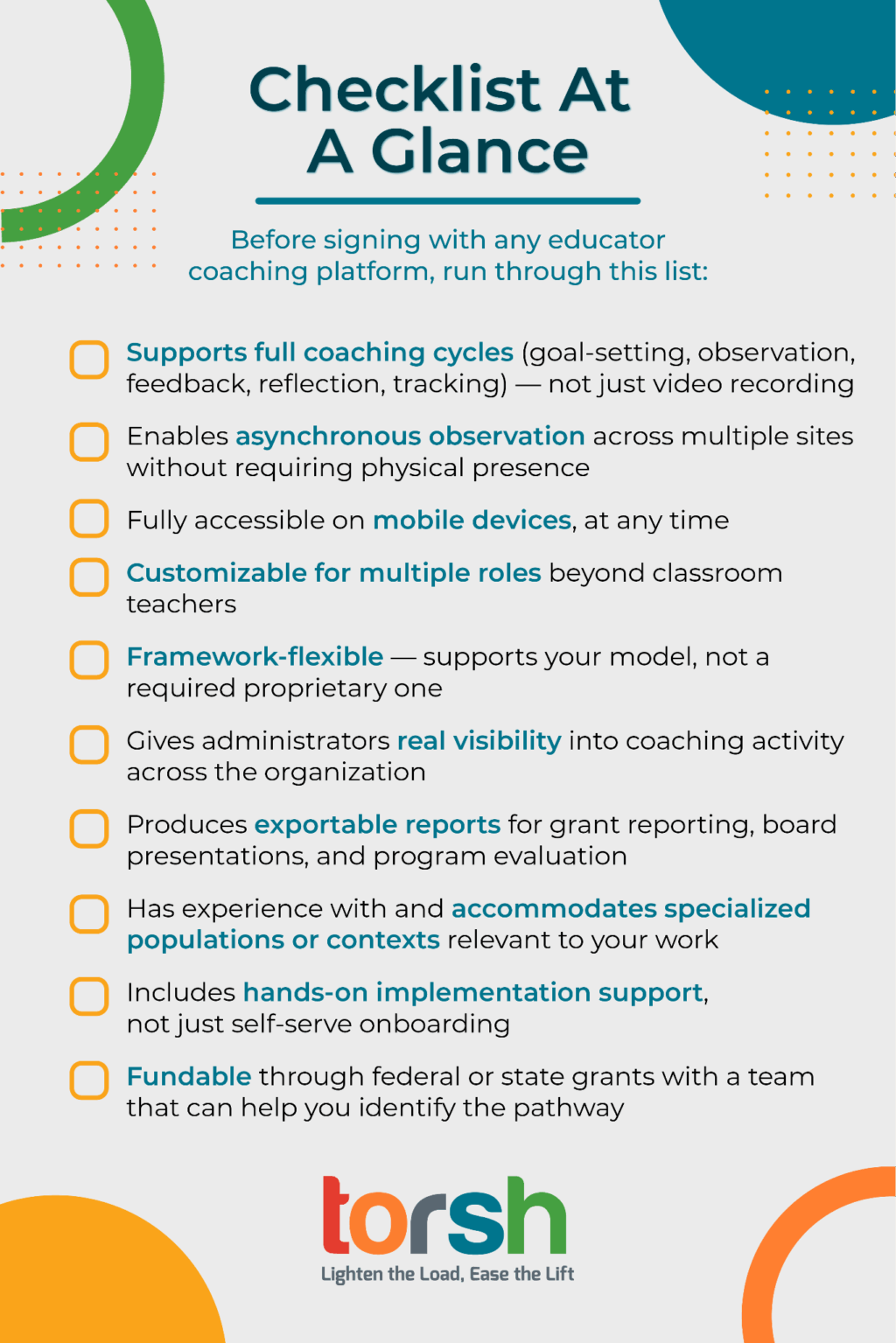
Before signing with any educator coaching platform, run through this list:
- Supports full coaching cycles (goal-setting, observation, feedback, reflection, tracking) — not just video recording
- Enables asynchronous observation across multiple sites without requiring physical presence
- Fully accessible on mobile devices, at any time
- Customizable for multiple roles beyond classroom teachers
- Framework-flexible — supports your model, not a required proprietary one
- Gives administrators real visibility into coaching activity across the organization
- Produces exportable reports for grant reporting, board presentations, and program evaluation
- Has experience with and accommodates specialized populations or contexts relevant to your work
- Includes hands-on implementation support, not just self-serve onboarding
- Fundable through federal or state grants with a team that can help you identify the pathway
- If a platform you’re evaluating can’t clearly answer yes to most of these, keep looking.
Finding the Right Fit
There’s no shortage of platforms that claim to support educator coaching. The ones worth your investment are the ones that treat coaching as a system — not a feature — and that understand the real conditions educators and leaders are working in.
TORSH Talent was built to meet every criterion on this list. It’s the coaching infrastructure behind some of the most effective professional learning programs in K-12, early childhood, early intervention, higher education, and childcare organizations across the country — framework-flexible, accessible on any device, and built to make coaching visible, sustainable, and fundable.
If you’re in the middle of this evaluation, we’d love to show you what it looks like in practice.